近日,98堂 、果蔬园艺作物种质创新与利用全国重点实验室宁国贵教授团队何燕红副教授在 The Plant Journal 在线发表题为“TeCYC2c functions as a hub protein in the CYC2 gene cluster to regulate ray floret development in marigold (Tagetes erecta)”的研究论文。该研究发现,万寿菊2号染色体上五个串联排列的 CYC2 基因构成一个整合的转录调控模块,其中 TeCYC2c 作为枢纽蛋白(hub protein)通过招募 TeCYC2b、 TeCYC2g,并促进 TeCYC2e1 对下游 TeCYC2e2 基因的转录激活,从而建立和维持舌状花身份;揭示了串联 CYC2 基因簇协同调控菊科舌状花发育的分子机制。
菊科是被子植物中最大的科,其标志性的头状花序由边缘艳丽的舌状花和中央负责繁殖的管状花精巧组合而成,是该科适应性与物种多样化的关键创新;舌状花的花冠形态既决定了对传粉者的吸引力,也直接影响观赏植物的园艺价值。CYC2 类基因长期被视为控制舌状花身份与花两侧对称性的核心调控因子,但在许多菊科物种中,CYC2 基因常常串联成簇、功能彼此交错,它们究竟是各自为政还是作为一个整体协同运作,长期不清楚。因此,解析 CYC2 基因簇的协同调控机制,对理解花型多样化演化、改良观赏植物花型具有重要意义。
本研究以万寿菊一个舌状花“管状化”的天然突变体 JH 为材料,结合精细定位、BSR-seq 与转录组分析,将控制该性状的基因锁定到2号染色体上一个370 kb 区间,且该区间含五个串联排列 CYC2 基因(TeCYC2e2、TeCYC2e1、TeCYC2c、TeCYC2g、TeCYC2b) 。研究发现,JH 突变体 TeCYC2c 启动子中新生的一个 MYB 识别元件(MRE)抑制了 TeCYC2c 的表达;通过RNAi 沉默 TeCYC2c 能够重现舌状花向管状花转变并发育出可育雄蕊的表型,确证了 TeCYC2c 是决定舌状花身份的关键基因。
此外,通过酵母单杂交、双荧光素酶和电泳迁移率变动等实验,研究进一步揭示了基因簇内的分级调控关系:TeCYC2c 蛋白本身并不直接结合 TeCYC2e2 启动子,而是先与 TeCYC2e1 形成异源二聚体,再由 TeCYC2e1 直接激活 TeCYC2e2 的转录,形成“TeCYC2c–TeCYC2e1–TeCYC2e2”的两步级联调控。跨 18 个菊科代表物种的比较基因组分析显示,CYC2 基因拷贝数在物种间差异巨大(1–28 个),但串联成簇是其最普遍的基因组织方式(14/18 个物种),提示这一基因簇架构在菊科中受到广泛的选择约束。本研究证明,串联重复的 CYC2 基因是作为一个协同的转录调控网络、而非彼此独立的单元运作的,为理解菊科头状花序的多样化演化提供了新的分子框架,也为观赏植物和作物花型的定向改良提供了潜在的分子靶点。
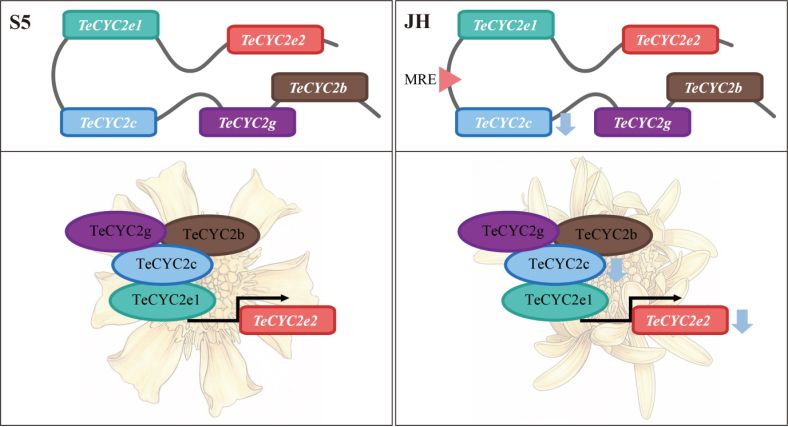
万寿菊CYC2 基因簇协同调控舌状花发育的机理模式图
98堂 博士后李航、已毕业硕士生朱钰、窦淋琳为该论文共同第一作者,何燕红副教授为通讯作者。98堂 包满珠教授、宁国贵教授、梁梅教授、硕士生胡诗蕊;植物科学技术98堂 刘元龙副教授,博士生汤锐恒;南京林业大学张春玲博士等参与了研究工作。该研究得到国家自然科学基金(面上,青年)(32172616, 32202534)的资助。
【英文摘要】
While CYCLOIDEA2 (CYC2) genes regulate floret identity and bilateral symmetry in Asteraceae capitula, the molecular mechanisms underlying coordinated regulation among clustered CYC2 genes remain unclear. We investigated how tandemly arrayed CYC2 genes function cooperatively to control ray floret development in marigold (Tagetes erecta). Using a natural tubularized ray floret mutant, we integrated bulked segregant RNA-seq (BSR-seq) analysis, transcriptome profiling, transgenic validation, and molecular interaction assays to dissect the regulatory mechanisms among clustered CYC2 genes. Five CYC2 genes (TeCYC2b, TeCYC2c, TeCYC2e1, TeCYC2e2, and TeCYC2g) are tandemly arrayed on chromosome 2, forming an integrated transcriptional module. A MYB recognition element insertion in the TeCYC2c promoter suppresses its expression, disrupting ray floret identity. TeCYC2c functions as a hub protein that recruits TeCYC2b, TeCYC2e1, and TeCYC2g through heterodimeric protein–protein interactions, facilitating TeCYC2e1-mediated transcriptional activation of TeCYC2e2. Comparative analysis across 18 Asteraceae species reveals extensive CYC2 copy number variation (1–28 genes) with prevalent gene clusters (14/18 species). CYC2 gene clusters operate as integrated regulatory networks rather than independent units, with cis-regulatory evolution driving functional specialization in ray floret development. These findings provide a molecular framework for understanding inflorescence diversification in Asteraceae.
论文链接://doi.org/10.1111/tpj.70978
通讯员:李航
审核:何燕红